Yule Logrolling

The other week I was asked to name my book of the year by the London Magazine. I chose Imogen Cassels’ Silk Work, a poetry collection that I think is the real deal. This kind of thing is always difficult. One problem, among others, is that a large chunk of the recently published books I read each year are by my friends, or people I know. In spite of the tininess of the poetry world, I do not meaningfully know Cassels, though in the spirit of complete disclosure I think I did once meet her at an academic conference in 2018. While I am, I want to stress, a brave outsider, excluded by the literary establishment because of DEI or the freemasons or whatever, you still end up meeting a lot of writers if you do it long enough, and some of them will end up getting published.
The ethics of literary journalism are mostly a silly thing to be concerned about. Some of the greatest reviews are examples of logrolling. Walt Whitman reviewed himself more than once. And he was mostly right about what he said. It has always seemed to me, when you read Private Eye complaining about writers giving their mates prizes etc, that this kind of corruption is not actually inherently bad. On this platform people complain about the club of professional writers etc (all while boosting each other). But wouldn’t it be worse if professionals treated the whole business with complete professionalism? To cut out all your loves, obligations and enmities strikes me as inhuman.
Still, I don’t personally review or recommend books by my friends in third party publications, because I don’t want my recommendations or reviews to feel like some kind of social currency. I don’t want people to owe me or to feel that I owe people. But I do owe my friends something, precisely because I admired their books. Honesty demands some kind of reckoning with this. To that end, here, in no particular order, are a few books by people I know which I admired this year. What I want to do in the little discussions is to articulate as personal a response as possible, in the hope that this will compel your assent without hiding any ‘bias’. If I can ‘show’ you what I see in it, I will have discharged the debt.
Caleb Klaces I have known for a few years, during which time he was generous to me as a stranger with similar interests who didn’t know anyone after moving to a new city. When I met him, he was writing this, his second novel. We sometimes talked about it, but I did not see it. I remember thinking the title was amazing. Reading it, I felt that I recognised the man I had come to know, both through his work and our meetings, but I also found myself seeing that same generous, lively sensibility transformed as it wrestled with extremely painful material.
Mr Outside is a stark, short work about a man packing up his father’s things as he prepares to move him into a care home. The narrator’s father, who was once a turbulent priest, now has dementia. As the narrator tries to put his father’s life in boxes, he tries and fails also to get closure, to keep a lid on his own feelings, to in general make things accord with how he wants them to be. His own pride as a writer, as someone who can tell a story or find a relevant detail begins, then to dissolve, his hold on what matters is shown to be precarious, and yet more important than ever. The title is the name of a figure the father blames for the disorder of his home, a character who represents dementia and forgetting, but who also reveals the difficulty of knowing others and ourselves. The depiction of the two men, each trying to hold on to their own version of the other, alternates between hilarious, frustrating, and unbearably sad.
What is most impressive, I think, is that you can feel a kind of heroic restraint and humility in the prose, a clear-eyed accounting of what this son owes his father, which grants, in the end a dignity in indignity I can only compare to Lear naked on the heath, achieved this time through quiet rather than thunder.
The garden was not the garden. He was by the sea. The cormorants were out on the rocks. Waves broke on shingle.
We walked along the seafront together. I felt self-conscious about the act, anxious he would snap out of the fiction and accuse me of mockery.
He felt the breeze on his hands and face. He heard the music from the arcade. I saw spots of blood on the ground. They turned out to be red leaves.
He winced, bent down to reach his foot, and lost his balance. I caught his arm.
His gaze flared with my face. He looked as though he had just woken up. His pupils startled wide.
I set him upright and smiled. I spread my arms. I asked him if I was what he’d been looking for.
He considered the question. Slowly he raised a pointing finger up to the heavens. It was blueish from the copper ring that he usually wore to combat headaches. ‘My foot hurts.’
He set his weight onto his tender foot. It caused him pain. But he had to keep looking. Something was missing.
He leaned against the tree and assessed his companion. I realised what was different about his face: he’d cut his long grey beard in half. He always trimmed stray hairs with the kitchen scissors. This time he’d sheared close to the skin, but only on one side. I’d never seen this much of his face. I asked him why he’d decided to cut off half his beard.
He ignored the question. He looked around, towards the place the sea had been. He stole a look at me out of the corner of his eye. Another look. He came to a stop.
‘There you are,’ he said.
‘Here I am.’
I have known Leon for many years, more than a decade at this point. I wrote something about her short story collection, Parallel Hells, earlier in the life of this blog. The Decadence is a novel that I saw in an early draft so the first thing I ought to say is that I am pleased Leon held her nerve about the pacing. Because The Decadence is, more or less ‘horror’, though of what philistine publishers might call the upmarket or elevated kind, I imagine there was pressure to bring the supernatural elements forward, to give the reader what they think they want sooner.
It is a haunted house story—a group of largely privileged friends escape the Covid lockdown by retreating to the country house of one of their number. There, however, they encounter an ancient evil that brings to light their own festering resentments and larger questions about identity in Britain. The novel can be read, like much horror—and like many only ordinarily horrific country house novels such as Howard’s End—as an allegory about belonging. In this case the ambivalent or complicated position of Jews in Britain as a minority whose participation in whiteness etc is a subject of debate. The novel’s focal point, Jan, a Jewish PhD student in medieval literature, is positioned uncomfortably between those characters who stand in for the British establishment (aristocratic Theo whose house it is), and those who are outsiders (Ursie, a self-made artist of Caribbean heritage). Neither side quite accepts that she belongs with them—they have arguments about politics, they have arguments about manners, they have arguments about sexual ethics. And then the question is, so to speak, settled by the ghost of the house.
But you have to wait for this. And this waiting is part of the successful formal structure that fortifies the allegory. There are two reasons, and I think taken together they amount to quite a clever combination. The first is that the wait for answers is a way of representing the more general question of antisemitism. While I personally am not swayed by the opinions seemingly given weight in the novel about the dangers posed to British Jewry by Corbynism, the novel works well with the more general history in which Jews have always experienced certain kinds of deniable prejudice; we might think of the restaurant scene in Roth’s Counterlife. The fact you have to wait so long to see the obvious truth that there are supernatural forces at work mirrors this subtlety. It also ironically echoes the style and pacing of the classic English gothic and ghost stories. It is a skilful gesture within and against assimilation.
Nevertheless, the allegory is not what I found so enjoyable. What I really enjoy about the book comes from the way the characters’ interaction is presented. At every moment, you see people for whome power is present in any given interaction, and bound up with pain and pleasure. In some ways, though the style of the dialogue is totally different, it reminds me of Harold Pinter. Craig doesn’t seem to be aiming for naturalism, but for a kind of BDSM camp, in which every moment is libidnally invested either in inflicting pain, or in staking out the status of victim or both. The one totally misguided review I have seen complained about the likeability of the characters (can you imagine someone saying this about Pinter?) but for me it’s a total delight to see this kind of plausibly deniable viciousness enacted, even in conversations that on the surface seem to be about nothing. Everything in the following passage is the giving of information, but each individual action here can be read as a criticism or a power play. It would be exhausting to live like that, but one can learn to take a kind of aesthetic pleasure in what ought to be called the microagression, in seeing it, in being hurt by it, and committing it. Leon’s writing in this novel is an education in that pleasure:
Ursie, sat at the other end of the outside table, lifted her head from her phone.
‘Is there a fire?’
‘Nope, just dinner.’
‘Do you need a hand? I thought we were done, sorry.’
‘Nearly! Can you nip into the dining room for me and grab the yellow citronella candles I saw sitting out, plus some of those net pyramid things to keep the gnats off the food?’
Jan watched her hurrying inside and added, ‘Please can you bring out some plates for us as well? The plain set if possible.’
We can’t be trusted with the fine china, then?
It’s more that I don’t trust myself with it, you know what a klutz I am.’
‘Sure.
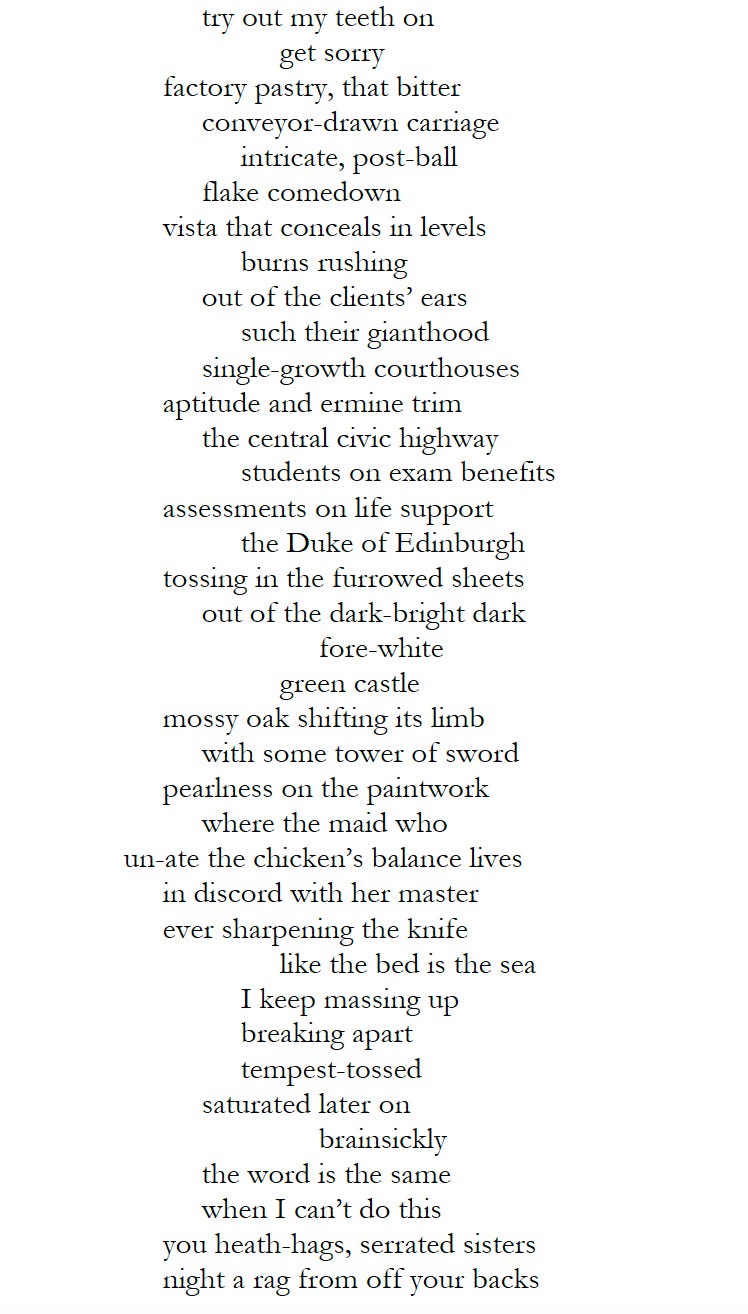
It is hard for me, at times, to separate most of my thinking about poetry from what I learned from Joe Minden. When I met him, at age 22, at a party, and realised that we both wrote poetry, I didn’t realise how much he would teach me. He helped me find ways of counterbalancing the abstractions of my poems and was the first person to notice the kinds of tics that I had to watch out for (aphorisms alternating with punchlines alternating with description). And then there were his own poems. The technical skill and the ambition was a lesson for me, who thought myself particularly gifted because I could turn out a vaguely functional formal poem.[1] Compared to Joe, I couldn’t do anything.
Joe continues to be one of the greatest makers of individual phrases in poems, and in this new collection he follows his ear into stranger and stranger places. The book comprises a long poem, Paddock Calls, a harrowing monologue about teaching in a school, and a seasonal cycle of little poems, dated that act as a record of moments of respite and attention, and a strange, as well as individual bangers like “Alfredston clergy house. The whole book draws on, I think, various ideas of what it might mean to be educated. Do we find easy answers forced on us? When can we be curious? How can we really learn from our experiences, or from literature? Such questions are asked and answereed, and jumbled up in ways that open up our experience. The style, in Paddock Calls, for example, is one which sort of races ahead. Rather than unpack a thought, Joe lets the rhythm skitter and then return to a study pulse, each time modulating a thought so that eating a Greggs breakfast or the like opens up on a world of experience:
What I admire about Sarah Howe’s Foretokens, her second collection of poems, is the dedication it shows to making a book out of its various parts. The book is initially seems to be somewhat chaotic. Poems about DNA and its discovery vie for space with poems about Howe’s mother doing the Laundry or a commission from the World Service, or poems about Paradise Lost, poems about the collections in Liverpool’s World Museum. Now, personally, I quite like when poems are individual and independent. But what quite often happens, especially with successful poets’ second books, is that a bunch of commissioned poems, written for various institutions that think poetry might somehow be useful to them, take the place of one’s own preoccupations. The books read as bitty and stop-start. The amazing thing about what Howe manages, is that you realise, somewhat too late that this is not what’s happening in Foretokens. By the time you are reading the final major poem, an elegy for Howe’s father, which is also about JH Prynne telling a dinner party story about the discovery of Chinese Music while Howe looks at a picture of one of the discoverers of DNA, you see that there has been a story told, of the poet’s effort to see patterns in chaos, which is moving as architecture, somehow. A rare feat. Not a project poem, but a set of poems that honour the core project of poetry. The individual themes, migration, identity, parenthood, become, in a way, instances of the poet’s own rage for order. In addition, the poems riffing on Paradise Lost have their own kind of excellence. Here’s a section of one, Eve’s Dream, which I think which I think shows Howe’s particular genius for a kind of sinuous looping, recursive adaptation of blank verse:
Last night I dreamt about the Fellows’ Garden –
I’ve not been back for maybe fifteen years.
Chagrined, I suppose, by the whiff of privilege.
We’d broken in, the way we sometimes did
as undergrads, stumbling out of hall or bops:
God, was that really what we called them? My friend
would mastermind these antics. I won’t say his name.
I recently resolved never again
to make a poem from another’s pain.
I can’t remember if he’d pinch a key
to the slender iron gate that’s hidden
round the eastern side. Or did he somehow pick
the lock? A rusty shriek, and he would cross
the moonlit sill like Adam leaving Paradise
in reverse – brandishing a half-full bottle
of red. I dreamt he led our drunken posse
in a here-we-go-round the mulberry tree . . .
they called it Milton’s mulberry, though who
can really know? It’s said the budding poet
drifted off beneath its raft of unripe
fruit, and when he woke, he wrote an elegy
for a friend, a fellow student, dead too young.
Or have I made it up, the bit about the nap?
We all gripped hands and stumbled flushed
around the spinning tree.
Various writers: Wind the Bobbin Up
As some readers may know, I am involved with a group called The Fair Organ. This is a multidisciplinary collective of artists who work collaboratively in response to traditional music. But it is also actually good. And the latest pamphlet connected to the group came out last month, featuring myself and many other excellent poets, writing poems, essays, and creating drawings etc in response to the children’s song ‘Wind the Bobbin Up’. It’s not a song I thought about much until I had a child myself. And then my first thought was why all the children’s songs have the same tune. Wind the bobbin up only uses a bit of the twinkle twinkle little star/bah bha black sheep/ etc melody. But it’s there. In an essay about the book, the redoubtable Rey Conquer talks about it as a way of articulating a kind of poetics they are drawn to, echoing also the simplicity of the political chant:
So I had been thinking about the nursery rhyme as a poetics, a model for the kind of poetry I wanted to be writing, and also the nursery rhyme as a form with political potential, when Edwina proposed the project.
I think I am drawn less to the chant, and to the tone of childhood. Indeed when I am inclined towards ‘philosophical’ thoughts about raising a child, they have often hinged on the problem of drawing someone into personhood through shared language. That these simple forms of shared language seem to me to be especially emblematic of reduction from the wonders of many forms to pointing to the ceiling and the floor on command, to working in a textile factory, is maybe silly or naive in its own way. But that is what I wrote about. Others, though, wrote charming love songs to babies, wrote about language and history, wrote about repetition and movement, wrote about childhood. And here I just want to highlight this poem by Charlotte Geater, which seems to me to be about the work of transformation that poetry accompanies. The effort to live, perhaps in envrionments unsuited to one, requires transformation, work to make play possible, and I thought that this was captured admirably in this poem:
Spangling my bobbins

2.

winding cloth around the bobbin
to make a doll
a little toy
it had been one type of body, before

my bobbin dolly
a long loved darling
for £8.53
with big painted eyes

a thin turned piece of wood
and a squat inner tube
thicker at each end
ready to be wrapped

strung together
an internal sense of self
red string, grey thread
skilling a
skeleton of wood
or plastic
start with a carved stick

the bobbins made into a bonfire
a fortress of
firewood, going door-to-door
long planks and
little things turned
around and around
some of them even decorated.
a face drawn in the ashes.

one turn in gauze.
scraps of thread for hair
and those spangles again
in the sun
to be earrings
or to open up her eyes

to sing this is a game as long as we play it
Non-fiction
I don’t alas have the energy to review every book in detail. And so non-fiction will have to suffer for now. As I like it less, that seems right. But I do commend to all my readers Sam Wetherell’s Liverpool and the Unmaking of Britain, Kristin Grogan’s Stitch Unstitch, Modernist Poetry and the World of Work, and Matthew Holman’s Frank O’Hara and Moma: New York Poet, Global Curator. Because these books have arguments that I might want to address at length, I will probably handle them in a separate post, as I will with The Opposite of Seduction: New poetry in German, edited by Alexander Kappe, Nicola Thomas and Jana Maria Weiss.
Hugh Foley, Recent Poems
A few copies of my pamphlet are still available. I’m not going to give it the full Whitman treatment, but if you’re interetsed, here’s a video of me reading one of the poems inside at the launch. Immediately after this I got a migraine and was bedbound for two days.
[1] For another time perhaps but this is the problem with most formalist verse. That the poet is satisfied merely by having written a successful formal poem, failing to remember that this is just a minimum.